
The Washington Department of Fish and Wildlife is working on increasing Chinook Salmon production in South Sound. A key component of that strategy is developing a new hatchery facility for the replacement of the Percival Cove rearing net pens that were removed over a decade and a half ago. The new facility will rely on the Tumwater Falls newly modernized adult hold/spawning for recruitment of adults and will also utilize it for rearing and release. The new facility will be developed upriver of the Deschutes Falls approximately 5 river miles. The new facility will require a surface water intake capable of withdrawing up to 21 cfs, and a ground water well able to supply up to 350 gpm pathogen free water for early life stage rearing. The facility will have 12-10×100 raceways 6-20×100 raceways, a hatchery building, administration building, shop/storage, public space, sediment pond/head tank, pollution abatement pond, effluent infiltration pond, and three residences. The project will look to incorporate micro hydro to assist in offsetting pumping cost and solar power to also offset general building electrical operational cost.
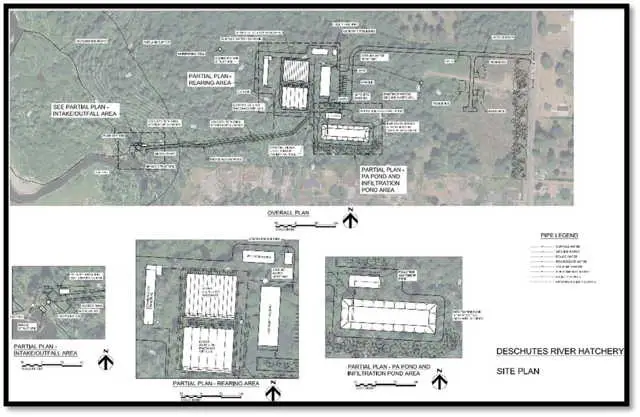
Because the Deschutes River has a TMDL for nutrient, and temperature, the initial design has been focused on the implementation of partial recirculating aquaculture systems (PRAS) to reduce the amount of surface water needed and as a way to more frequently remove unfed feed and fish waste. In addition, the PRAS system will offer additional measures for water disinfection with UV units installed in the PRAS loop.
The waste collection system will comprise of vacuuming, holding waste in two cell clarifiers with the decant water shunting off to an infiltration pond where a portion of the infiltration water will be out flow water from the facility. These measures are needed to meet the TMDL requirements of the future NPDES individual facility permit.
The facility will also incorporate public space for educational purposes.